The Eight Pillars of Income First: What the Method Stands On
Income First rests on eight pillars: execution is 99%, income comes first on purpose, watch the four vitals, engineer consistency with systems, every idea can work, every path must be built, it's emotional, and a business should become an asset.

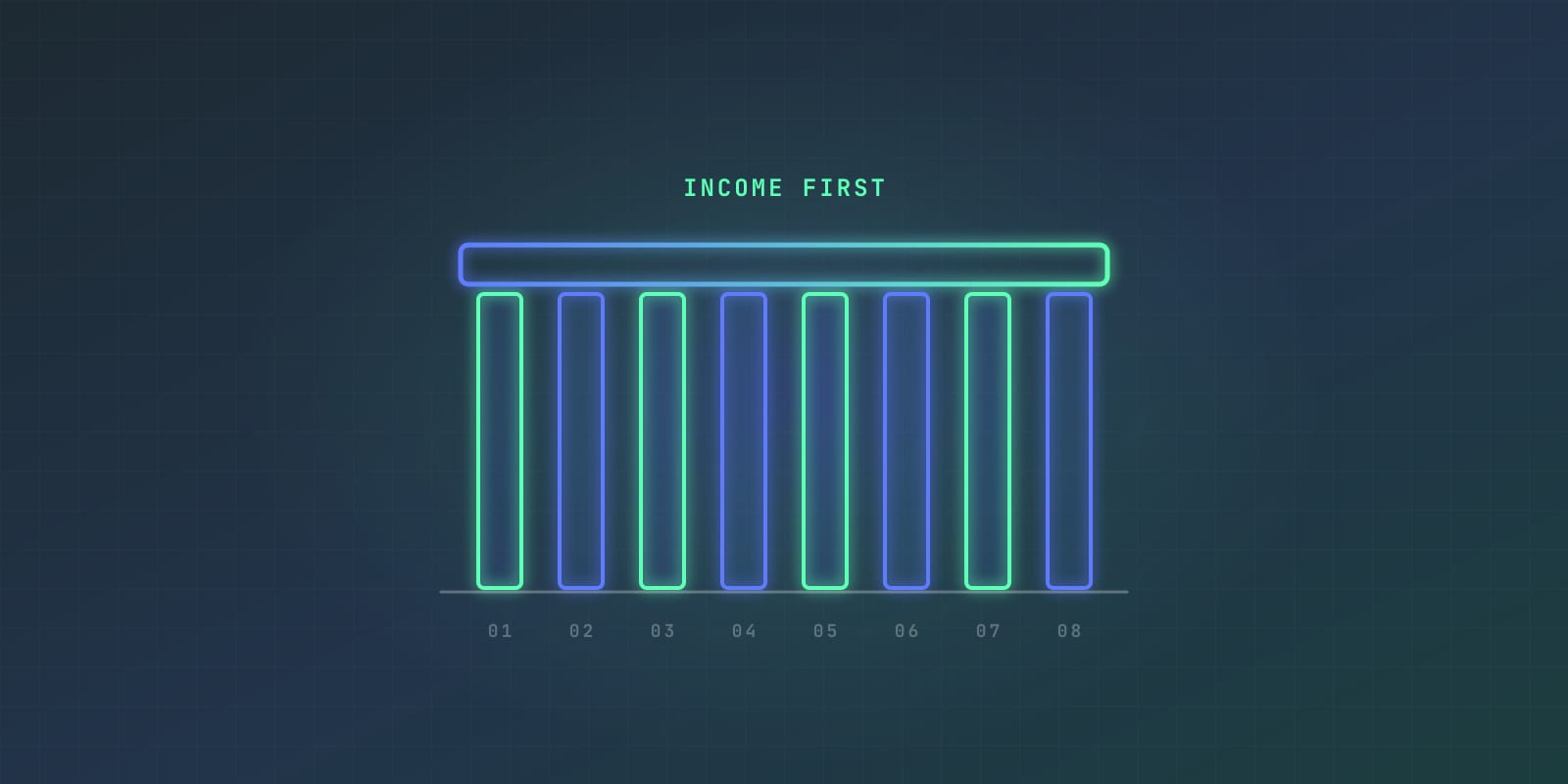
Income First stands on eight beliefs. Execution is 99%. Income comes first, on purpose. Watch the four vitals. Engineer consistency with systems. Every idea can work. Every valid path still has to be built. Entrepreneurship is emotional. A business should become an asset.
That's the whole list. I call them the eight pillars, because that's what they do. They hold the thing up. Pull one out and the building leans.
They're not ranked. I numbered them so we can talk about them one at a time, and for no other reason. And the list isn't finished either. Eight is not a magic number, it's just the ones I'd defend in a room full of people who disagree with me.
Here they are, one by one, with why each one matters and where the site goes deeper.
1. Execution is 99%
The idea is one percent. Everything you do after it, the asking, the selling, the fixing, showing up again tomorrow when nobody clapped yesterday, is the other ninety-nine.
Everyone is in love with ideas. The flash in the shower, the napkin, the "this could be huge". For a moment you feel like you've done something. You haven't. You had a thought.
I learned this the embarrassing way. I rebuilt my landing page four times and called it "working on the business". Nobody had paid me for anything yet.
Why it matters: it kills the fear that someone will steal your idea. Hand the same idea to ten people and you get ten different outcomes, because the ninety-nine is yours. And it gives you permission to start before you feel ready. The market doesn't grade your starting point.
2. Income comes first, on purpose
Income is the top priority, not the first thing you do. "First" means priority, not sequence, and the Income First page explains that better than I can in a paragraph.
The word that matters here is "on purpose". Not "the money will come eventually". You decide it, and then every decision answers to it.
Here's the test I use on myself. New website? Fine. What's the path from this website to someone paying me? Rebrand, networking event, a fancier proposal template, same question, out loud. Sometimes the path is short and real. Sometimes I hear myself describe something so long and foggy that I realize I'm avoiding the scary part again. The scary part is almost always the same: asking someone to pay.
Why it matters: if it doesn't make money, it's not a business. It's a hobby with a logo.
3. Watch the four vitals
An Income First business steers by four numbers, and every move should serve at least one of them. I'm not going to relist them here, they live on the vitals section.
The one I want to talk about is effort, because it's the one nobody puts on the dashboard. I scaled a business to around fifty people. From the outside it was working. The money numbers looked healthy. Effort was screaming, and I wasn't tracking it. One day I realized I was the load-bearing wall: pull me out and the whole thing cracks.
Why it matters: the vitals fight each other. You can buy revenue with effort. You can cut a cost and land the work back on your own calendar. Watch one dial and you end up rich and exhausted, or busy and broke. If you want a 2-minute version, run income over effort.
4. Consistency is engineered with systems
Consistent effort over time is not a character trait. It's an output, and outputs come from systems.
For years I ran the most important work, the reaching out, the following up, on pure motivation. Good days, I was a machine. Bad days, nothing. My results looked like a heartbeat monitor. I thought I had a discipline problem. I had a systems problem.
A system is boring on purpose. A fixed time, a trigger that's already in your day, a number. Say five conversations every morning, before email. Five on a Monday is nothing. Five a day held by a system that doesn't care about your mood is well over a thousand a year.
Why it matters: a system lowers effort. You decide once instead of every morning. And it takes the guilt off you, because you hit the number and you're done. Genuinely done.
5. Every idea can work
There are no bad business ideas. There are un-executed ones and un-sold ones.
Your first idea won't survive the first ten real conversations anyway. You'll change the audience, the outcome, the price. So the question "is this a good idea?", asked alone in your head, is almost meaningless. That's why we don't call it an idea. We call it a seed, and the Seed Offer post is about exactly that.
And even if you're bad at changing it... volume can carry a weak offer a surprisingly long way. Talk to enough people and someone buys. Alex Hormozi calls it sheer volume.
Why it matters: it ends idea-shopping. Searching for the perfect idea feels like diligence. It's actually the most sophisticated form of avoidance there is, because as long as you're still choosing, you never find out you were wrong.
6. Every valid path still has to be built
There are endless ways to build a business, and they all work, if you build the business.
This method is one of them. I believe in it. But it's not scripture. People build real, profitable businesses with maps that look nothing like mine. The only test I care about is the one at the end: did it make a profitable business?
The important word is "if". A perfect model you never build is worth nothing. A mediocre model you actually build, sell and run is worth a living.
Why it matters: it's a permission slip and a responsibility at the same time. You can stop searching for the right model. And you can't hide behind "I picked the wrong one" anymore. There's only built or not built. Also, stop comparing. Their business looking nothing like yours just means two valid paths.
7. Entrepreneurship is emotional
Most of what decides whether you make it isn't strategy. It's whether you can keep going through the feelings.
The fear before you ask for the sale. The sting of the no. The flat afternoon after a launch nobody noticed. I once spent days on a "killer" post and got 3 likes. I wanted to hide. Then I wanted to break something. Then I went to the gym, came back and figured out what happened. I wrote the whole thing up in Start, Crash, Learn, Repeat.
People don't avoid selling because they don't know how. They avoid it because of how it feels. "Now's not the right time", "let me learn a bit more first"... that's avoidance with a better vocabulary. I know, because I said all of them.
Why it matters: once you know the shape of the loop, the crash stops surprising you. You know the next stage is lighter. You're jumping from the plane, but this time you know how landing feels.
8. A business should become an asset
The destination is a passive asset: a business that keeps paying you without needing you in it every day.
A business is a car. You build it to get somewhere. Somewhere along the way it's easy to start serving the car instead, until the thing that was supposed to carry you is a seat you can't get out of. The move is to put a driver in it.
This one is "eventually". At the start you are the business, and that's correct. The mistake is never building toward the day you aren't. If you stopped showing up, how fast would the money stop? If the answer is "almost immediately", you own a job.
Why it matters: it turns work into an option instead of a condition. You can keep working forever if you want. The difference is that it's a choice.
One pillar, one action
Read them again and you'll notice they're the same idea from eight angles. Pull on one and the others come with it.
So here's your homework. Pick the pillar that hit you hardest. Usually it's the one you most want to look away from. Do one concrete thing about it before tomorrow ends. Not all eight. One. Message the person. Write the two numbers. Put the five conversations in your calendar at 8am.
If the pillar that stung was "income comes first" and your income still depends on referrals, come to the free Thursday masterclass. That's exactly what we work on there.
Take what resonates with you and try it—or not!